Industrial 3D Printer Buyers Guide
Over 77% of printers marketed for high performance polymers can’t reliably print PEEK or ULTEM. Make your next investment with confidence, not consequences.

Each year, McGill’s Formula Electric (MFE) team designs and builds a one-of-a-kind fully electric race car to compete in the Formula SAE Electric competition. The program challenges engineering students to develop high-performance vehicles while operating under strict budget and manufacturing constraints.
Unlike mass-produced vehicles, Formula SAE cars rely heavily on low-volume, custom components that evolve rapidly throughout the development cycle. Teams must constantly redesign and manufacture parts as the vehicle architecture matures through testing and validation.
To support this process, the McGill Formula Electric team turned to AON3D Hylo, allowing them to directly manufacture end-use components in high-performance polymers with metal-like properties.
AON3D Hylo allowed our team to produce race-ready parts quickly and affordably, with mechanical, thermal, and fire-safety properties far beyond what we could achieve with desktop 3D printers.
Zaven Renaud, McGill Formula Electric, Powertrain Manager
The Challenge
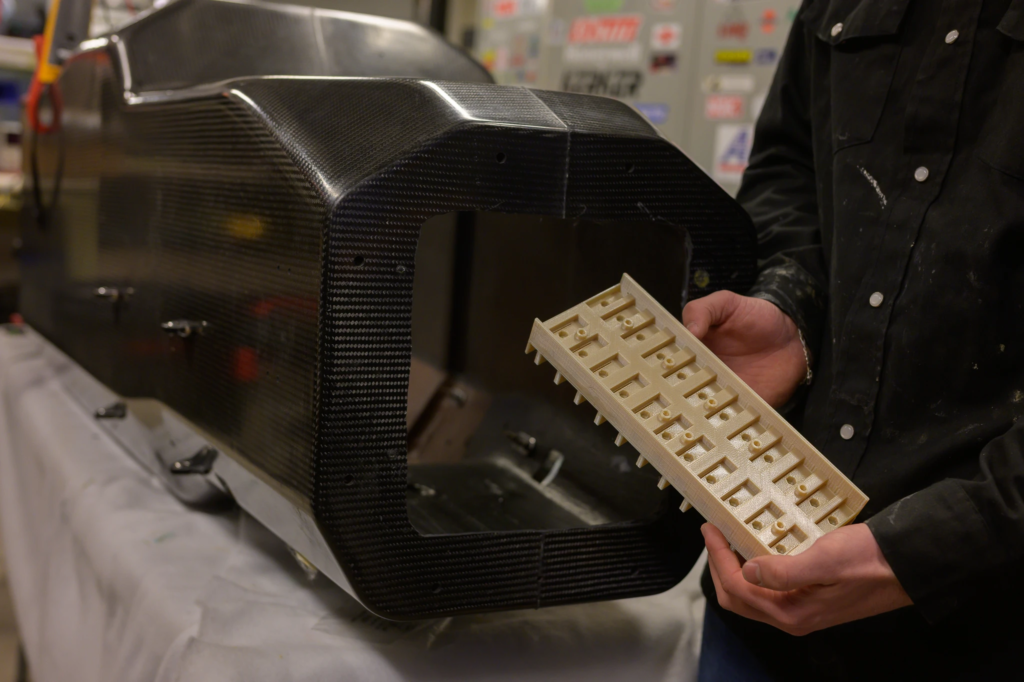
One such component was a battery cell and PCB holder used inside the vehicle’s high-voltage accumulator (battery pack). The holder secures pouch battery cells while supporting a printed circuit board responsible for monitoring and control within the battery module.
Components located within the accumulator must maintain reliable mechanical retention while preserving electrical isolation and thermal stability. Because the system contains high-energy lithium cells, materials used in this environment must also demonstrate controlled flame behavior and minimal emissions during a thermal event.
Conventional manufacturing methods require custom tooling or machined components, both of which introduce cost and lead-time challenges for parts that may require multiple design iterations during development. In contrast, materials commonly used on desktop 3D printers lack the mechanical, thermal, and electrical properties required for the application.
The Solution
Using AON3D Hylo and ULTEM™ 9085, the McGill team was able to iterate and manufacture functional end-use battery holders capable of operating within the demanding environment of a high-voltage battery system.
With a tensile strength of 94 MPa, flexural strength of 129 MPa, and a heat deflection temperature of 169°C, ULTEM 9085 maintains structural integrity and dimensional stability under extreme vibrations, high mechanical loads, and operating temperatures up to 60 °C.
In addition, UL94 V-0 flame retardancy helps prevent flame propagation in the event of a battery thermal incident, while extremely high volume resistivity (>6.89 × 10¹⁵ Ω·cm) ensures reliable electrical isolation near energized components.
Cost & Development Benefits
With AON3D Hylo and ULTEM 9085, the McGill Formula Electric team produced complex, low-volume components without the tooling costs or lead times of traditional manufacturing. Rapid iteration and the ability to consolidate complex geometries into single parts—without increasing cost—reduced assembly complexity and accelerated development, allowing the team to spend less time sourcing parts and more time improving vehicle performance.
Achieve New Levels of Part Performance & Throughput
3D print the world's highest performance polymers - bigger, faster, and stronger than ever.