Industrial 3D Printer Buyers Guide
Over 77% of printers marketed for high performance polymers can’t reliably print PEEK or ULTEM. Make your next investment with confidence, not consequences.

Polyetherketoneketone (PEKK) is a high-performance thermoplastic that belongs to the polyaryletherketone (PAEK) family. However, unlike most PAEKs, PEKK is a copolymer, enabling control over processing temperature and crystallization rate.
PEKK exhibits excellent high-temperature performance, biocompatibility, mechanical properties, and chemical and radiation resistance. It can also be processed using various techniques, such as additive manufacturing and injection molding. In particular, PEKK is one of the most favored PAEK polymers for 3D printing.
This article reviews PEKK’s unique properties and applications.
What is PEKK?
PEKK is a high-performance thermoplastic with a high strength-to-weight ratio. It can be used as a metal alternative in various demanding applications, such as automotive, biomedical, and industrial applications.
It was first developed in the late 1980s for aerospace applications. However, in the early 2000s, its composition was improved, enabling more use-cases.
PEKK is mainly composed of ketone and ether groups. It is a copolymer made by combining two molecular segments, i.e., terephthaloyl (T) and isophthaloyl (I) moieties.
PEKK Material Structure

PEKK is composed of repeating units of phenylene rings connected via ether (O) and ketone (C=O) linkages. Ketone groups give the polymer its high dimensional and thermal stability as well as its chemical resistance, while ether linkages provide the chain with flexibility.
Amorphous vs Semi-Crystalline PEKK
PEKK comes in amorphous and semi-crystalline forms. Controlling the T/I ratio (balance between terephthalic and isophthalic precursors) allows manufacturers to control the crystallinity of PEKK. A high T/I ratio gives a regular and symmetrical chain that can be easily packed into crystals, resulting in a semi-crystalline polymer, whereas a low T/I ratio leads to an irregular chain and an amorphous polymer.
PEKK polymers with higher terephthalic content (T/I ratios of 60/40–80/20) have higher chain rigidity, leading to high glass transition temperatures and melting points.
Choosing between amorphous and semi-crystalline PEKK depends on the application. For example, if higher thermal resistance is required, semi-crystalline is preferred, but an amorphous structure is better for 3D printability.
A common strategy with this polymer is to print amorphous PEKK and then anneal it to convert it to a semi-crystalline form, leveraging the easier printability of the amorphous structure and the enhanced thermal and chemical properties of the semi-crystalline one. However, this comes down to most high temp printers not able to reach the necessary temperatures. Printing at higher temperatures is preferred to post-annealing. While annealing will help with crystallinity, it will not remedy the poor interlayer welds as a stemming from printing at low temperatures, resulting in lower z-strength.
PEKK Material Properties
The properties of PEKK depend on its structure and form, e.g., filaments and powder. Material selection should be based on the available equipment and the final properties required for the product.
The properties discussed here are based on semi-crystalline and amorphous PEKK filaments. In 3D printing, these values depend on the printing direction (see last passage). Other forms of the polymer may have different values.
PEKK Physical and Mechanical Properties
| Property | Typical value/Rating |
| Density (g/cm³) | 1.26–1.27 |
| Tensile Strength (MPa) | 85–100 |
| Flexural Strength (MPa) | 125–150 |
| Impact Strength (kJ/m2) | 5–6 |
| Young’s Modulus (GPa) | 2.5–3.2 |
| Flexural Modulus (GPa) | 2.2–3 |
| Hardness | 79.9 Shore D |
| Elongation at Break | 4%–15% (semi-crystalline), 20%–100% (amorphous) |
| Creep Resistance | high |
| Fatigue Strength (MPa ) | 50–100 @10⁷ cycles |
| Coefficient of Friction | 0.35–0.45 |
Strength and toughness
Both amorphous and semi-crystalline PEKK polymers exhibit a high strength-to-weight ratio, with impressive tensile and flexural strength.
Moreover, the impact strength of semi-crystalline PEKK is comparable to that of PEEK, with amorphous grades surpassing both. Thus, the toughness of amorphous PEKK is higher than that of semi-crystalline PEKK and PEEK, with higher elongation at break. This can be attributed to its chain mobility, which allows energy dissipation through plastic deformation.
Therefore, if the application requires more rigidity, semi-crystalline is more suitable, and when flexibility and toughness are required, amorphous should be aimed for.
Stiffness
PEKK has a high Young’s modulus (2.5–3.2 GPa), which can be significantly enhanced with reinforcement.
Thus, PEKK exhibits very good stiffness, with carbon fiber–filled grades offering stiffness approaching that of aluminum alloys.
Hardness and deformation
PEKK exhibits excellent hardness, with a value of about 80 shore D. Semi-crystalline PEKK has a superior surface hardness compared to high-performance polymers, including PEEK. This makes it a competitive material for several engineering applications requiring excellent hardness.
On the other hand, the amorphous form offers ductility and is more suitable for applications requiring flexibility.
Cyclic loading performance
PEKK offers high fatigue resistance (up to 100 MPa after 10⁷ cycles for filled grades). This impressive cyclic loading performance enables its use for applications under repeated stresses, compression, or stretching, e.g., pistons and engine components.
Wear resistance
The coefficient of friction of PEKK is similar to that of PEEK, setting in a moderate range of 0.35–0.45. However, it shows a high wear resistance (wear rate = 0.5–1.5 × 10⁻⁶ mm³/Nm), approaching that of ultra-high-molecular-weight polyethylene (UHMWPE). Thus, it can be used in dry-running applications, such as bushings and bearings used in semiconductor handling equipment.
PEKK Thermal Properties
| Property | Typical value |
| Glass Transition Temperature (Tg) | 160 °C–165 °C |
| Melting temperature (Tm) | 300 °C–340 °C |
| Heat Deflection Temperature (HDT) | ≈139 °C (amorphous)–250 °C (semicrystalline) |
| Maximum Operating Temperature | 160 °C (amorphous)–260 °C (semicrystalline) |
| Thermal Conductivity (W/m∙K) | Avg. 0.21 |
| Coefficient of Linear Thermal Expansion (CLTE, µm/[m*°C]) | 26.5–53 |
The glass transition temperature and melting point of PEKK are equal to or higher than those of PEEK (depending on the grade). Also, similar to PEEK, its semi-crystalline forms can be used up to 260 °C. These outstanding thermal properties make it an excellent candidate for constant use at high temperatures without significant deterioration.
PEKK can also be used as a thermal insulator owing to its low thermal conductivity (≈0.21 W/m∙K).
PEKK Chemical Properties
| Property | Value/Rating |
| Solubility in Different Solvents | Semi-crystalline resists most organic and inorganic chemicals, except very strong acids, especially at high temperatures. Amorphous is less resistant than the semi-crystalline type. |
| Oxidation Resistance | High resistance at elevated temperatures |
| Flammability UL94 | V0 (self-extinguishing) |
| Limiting Oxygen Index (LOI) | 35% |
| Moisture absorption | 0.1%–0.6% |
Chemical resistance
PEKK, especially its semi-crystalline form, is extremely chemically resistant. Except for very strong acids, it resists almost all organic and inorganic chemicals and lubricants. Its amorphous form also offers good chemical resistance.
Flammability
PEKK has excellent flame resistance, with a UL94 V0 rating. The limiting oxygen index of PEKK is 35% (> oxygen percentage in the atmosphere, 21%), which means it cannot sustain combustion under standard atmospheric conditions. This allows its use in critical parts of airplanes and spacecraft.
Hydrolysis resistance
PEKK’s water absorption is very low, allowing it to handle wet media and to be used under humid conditions. This exceptional characteristic makes PEKK an excellent choice for parts subjected to steam, such as in food processing and biomedical applications, and water, such as offshore oil applications.
PEKK Electrical Properties
| Property | Typical value |
| Dielectric Constant | 2.95–3.4 |
| Dielectric Strength (kV/mm) | 20 (3.2 mm)–84 (0.1 mm) |
PEKK offers excellent dielectric properties at high temperatures, with an exceptional dielectric strength comparable to PEEK. Thus, PEKK can be used for several electrical applications, such as electrical insulators, 5G antennas, and circuit boards.
Other Qualities
Radiation resistance
PEKK has excellent resistance to high-energy radiation, i.e., gamma and X-rays. It maintains its mechanical properties under high-radiation conditions. This allows its use for instruments and tools in radiation-exposed environments, such as nuclear power plants.
Dimensional stability
PEKK has outstanding dimensional stability due to its high operating temperature, high creep resistance, and low water absorption. However, the amorphous form has lower dimensional stability than the semi-crystalline polymer.
Biocompatibility
Medical grades of PEKK offer a superior alternative to metal for human implants, preventing corrosion problems. They are FDA-approved, with an elastic modulus that matches that of bone, reducing the stress-shielding effect typical for conventional metal bone implants. These implants exhibit no radiographic interference or fibrotic tissue membrane formation.
PEKK Material Applications
Aerospace and Automotive
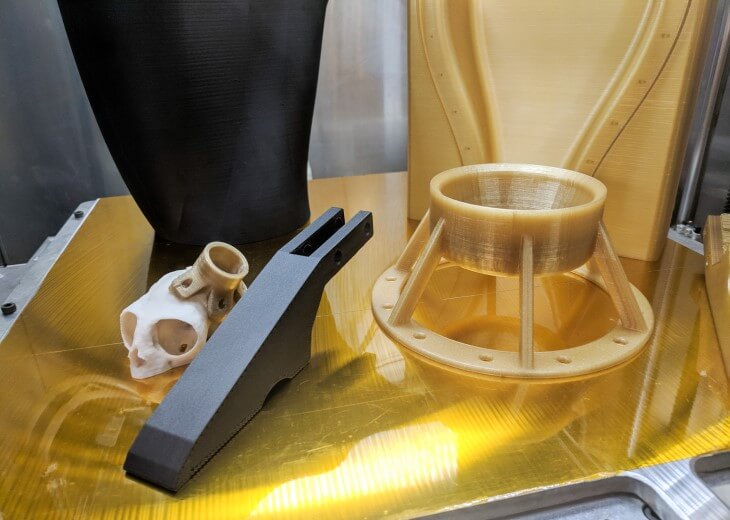
PEKK has numerous uses in aerospace and automotive applications owing to its high strength-to-weight ratio and easier 3D printing process compared to some high-performance thermoplastics, such as PEEK. For example, it can be 3D-printed into complex, one-part air ducts, saving time and reducing production costs. It is also used for brackets, interior components, and engine parts in automobiles, airplanes, and spacecraft.
Biomedical
Because of PEKK’s high thermal, chemical, and hydrolysis resistance, it can withstand sterilization and different disinfectants. Medical-grade PEKK is used in endoscopes, dental instruments, surgical instruments, and dialyzers.
It also finds use in orthopedic, neurological, spinal, and cardiovascular implants and medical devices as a suitable alternative to metals.
Industrial, Chemical, and Oil & Gas
PEKK can be used for parts that can benefit from its lightweight as well as its chemical and thermal resistance. Some grades of PEKK exhibit exceptional chemical performance at elevated temperatures.
Owing to its relatively good printability, PEKK can be used to form custom parts and tools. Examples of parts where PEKK is used in industrial settings include brackets, valves, ducts, housings, composite pipes, and flexible flowlines and risers.
Electrical
Due to its high mechanical, chemical, and thermal properties combined with its high electrical insulation, PEKK is used for several types of wires and cables used under severe chemical and thermal conditions.
Other PEKK electrical applications include coaxial connector jacks, hands-free devices, and surface-mounted trimming potentiometers.
PEKK Composites
There are several grades of PEKK made for specific applications, such as medical-grade and high-chemical-resistance PEKK. Moreover, PEKK composites are made by filling the polymer matrix with materials, such as continuous or short carbon fiber, glass fiber, and carbon nanotubes.
Carbon fiber filling endows the polymer with higher strength and wear resistance without significantly affecting its weight.
Glass fiber gives a similar enhancement to carbon fiber at a lower price point, but it increases the material’s weight.
Carbon nanotubes improve the material’s mechanical performance and impart consistent electrostatic dissipation (ESD) performance.
Comparison to Other High-Performance Polymers
| Property | PEEK | Polyphenylene Sulfide (PPS) | Polyethersulfone (PES) | PEI (Ultem) | PEKK |
| Continuous operating temperature | 260 °C | 250 °C | 220 °C | 170 °C | 260 °C |
| Thermal stability | Highest | Lower | Lowest | Moderate | Crystalline grades are equivalent to or higher than PEEK |
| Mechanical properties at high temperatures | Most consistent performance | More brittle than PEEK, but considerably better wear resistance | Lower performance than PEEK | Good up to 170 ° C, drops off above | Comparable (semi-crystalline) or slightly lower than (amorphous) PEEK |
| Chemical resistance | Excellent | Better than PEEK with some chemicals | Lower than PEEK | Moderate | Excellent |
Semi-crystalline PEKK exhibits mechanical, chemical, and thermal properties comparable to those of PEEK, with some superior properties. For example, the Tg of PEKK is higher than that of PEEK (PEEK Tg = 143 °C, PEKK Tg = 160 °C–165 °C), granting it high strength at higher temperatures. Amorphous PEKK has lower overall performance than PEEK; however, it has superior chemical resistance to PEI and PPS, and it shows higher environmental stress cracking resistance.
Moreover, PEKK is easier to print than PEEK, requiring lower processing temperature because of its lower crystallinity, even in its semi-crystalline form. PEKK also has a distinct advantage over most high-performance polymers as its properties can be tuned according to the application by controlling the material crystallinity.
PEKK 3D Printing
PEKK is typically printed using Fused Deposition Modeling (FDM) or Selective Laser Sintering (SLS).
In FDM, PEKK exhibits excellent adhesion to the printing plate because of its slower crystallization, which prevents warping. The material should be pre-dried for six to eight hours at a temperature higher than 120 °C to avoid bubbling and brittleness, and the printing chamber should be preheated to minimize internal stresses.
SLS is preferred for producing complex shapes, but it requires higher temperatures. However, PEKK is more forgiving than PEEK and can be processed within a wider temperature window.
Annealing can be used to enhance the material’s mechanical and chemical properties, especially if amorphous PEKK is used.
In summary, PEKK is an excellent high-performance thermoplastic that can be used in various applications. It exhibits high strength and chemical resistance comparable to PEEK, with a higher glass transition temperature. PEKK is one of the easiest high-performance thermoplastics to 3D print, requiring milder conditions and fewer precautions.
Achieve New Levels of Part Performance & Throughput
3D print the world's highest performance polymers - bigger, faster, and stronger than ever.