
Amorphous Polymers Explained with Examples
Nov 16th, 2026 • 9 min read
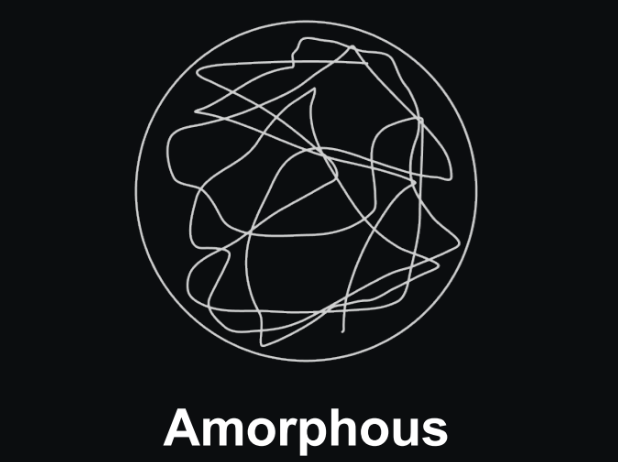
Amorphous means “with no defined shape”. This is exactly what amorphous molecular chains look like. Amorphous polymers are a class of plastics with long, tangled molecular chains, resulting in a disordered, random structure, and they lack the orderliness and repetition of crystalline chains.
This disordered structure affects several aspects of these materials’ properties, processing, and service performance. The unique structure of amorphous polymers and the lack of a sharp melting point allow easier molding and processing compared to crystalline polymers.
In this article we will take a closer look at the molecular build and what it brings about in material properties with some of the more common and widely used amorphous polymers as examples.
The Chemistry and Structure of Amorphous Polymers
Like any polymer, amorphous polymers are composed of long chains of repeated units. However, unlike crystalline polymers, these chains are disordered and entangled like spaghetti, as in the picture above. Polymers are generally considered amorphous if their crystalline content is less than 25%.
But why can’t some polymers form an ordered structure?
This depends on several factors. Chain regularity is the dominant one affecting the ability of polymer chains to be packed into ordered units. Polymers with simple backbones, such as polyethylene, or with regular structures, such as polytetrafluoroethylene (PTFE), are easily packed into ordered structures.
Irregular polymers, such as atactic polymers, where the side chains are arranged in a completely random order, are typically amorphous. If the same polymer is isotactic (all side chains are on one side) or syndiotactic (alternating), the polymer could be semicrystalline.
As said, there are other factors:
- Chain flexibility also affects chain packing. Flexible backbones containing bonds like C–C, C–O, and Si–O can facilitate packing, while stiff and bulky side chains can hinder it.
- Irregular branching can hinder packing, while linear chains favor it.
- Extensive crosslinking in a polymer network can also prevent chains from arranging into crystals.
- Random copolymerization can make chain packing difficult because the different monomer units cannot always be arranged in a regular pattern.
- Other factors affecting molecular packing include strong interactions, such as hydrogen bonding, among molecules, which stabilize the formed crystal, and cooling rate, as slow cooling induces crystallinity and vice versa.
This molecular disorder is what gives amorphous polymers their unique properties. For example, most amorphous polymers are transparent, as light can pass through them with minimal scattering.
Let’s discuss what differentiates amorphous polymers from semicrystalline polymers, and what makes them unique.
Amorphous vs Semicrystalline Polymers
While an amorphous polymer is made of tangled chains with few or no crystalline regions, semicrystalline polymers are made of amorphous regions, containing tangled chains, together with ordered crystalline regions.
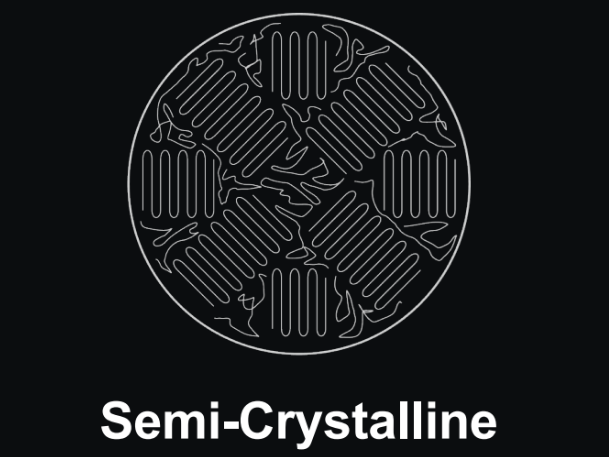
In semicrystalline plastics, the crystalline regions reinforce the polymer structure via physical crosslinking. This endows the polymer with better chemical and thermal resistance and dimensional stability above the temperature at which the amorphous phase of the polymer starts to soften.
One critical difference during processing of amorphous vs. semicrystalline polymers is their degree of shrinkage. Due to their crystalline regions, semicrystalline plastics experience higher shrinkage (typically 1.0%–3%) than amorphous ones (approximately 0.2%–0.8%).
Amorphous polymers are generally preferred when transparency, complex structures, and/or close tolerances are required. On the other hand, semicrystalline polymers are often selected in cases requiring thermal, chemical, wear, and/or fatigue resistance.
Finally, the behavior of both types of polymers under heating also affects polymer selection and processing. For example, most properties associated with the solid state of semicrystalline polymers, such as dimensional stability and stiffness, disappear once their melting point is reached, while this property loss happens gradually in amorphous polymers.
The thermal behavior of amorphous plastics is discussed in detail in the next section.
Thermal Behavior of Amorphous Polymers
One of the main differences between amorphous polymers and their crystalline/semicrystalline counterparts is their thermal behavior. Unlike crystalline polymers, which have a sharp melting point, amorphous polymers gradually change from the solid state into the liquid state. First, they start to soften into a rubbery material and gradually transform into a liquid.
The temperature at which an amorphous material changes from its hard (glassy) solid state to a rubbery state is called the “glass transition temperature (Tg)”.
Far below Tg, the polymer segments have limited mobility. This gives the polymer its high stiffness, dimensional stability, and glass-like nature. When an amorphous polymer reaches Tg, the glassy solid enters a rubbery state, called “the rubbery plateau”, in which the polymer softens but maintains some resistance to deformation because its chains are still entangled.
With the increase in temperature above Tg, this rubbery state gradually changes into a viscous flow state. Well above Tg, the material flows more readily because the chains easily slide over each other owing to the increased molecular motion.
The processing temperature depends on several factors in addition to Tg. These factors include molecular weight and viscosity, additives, and thermal degradation. For example, the Tg of polystyrene is approximately 100 °C. However, it is typically processed at 160 °C–260 °C, depending on the processing technique. Thus, Tg should not be treated as a melting point or a processing temperature. Instead, a processing temperature range should be defined for each amorphous polymer.
Properties of Amorphous Polymers to Consider in Engineering
Service Temperature
One may think that Tg could be used as the service temperature of all amorphous polymers. However, this is not the case. Tg acts as a reference and guide, especially for rigid polymers. It serves as a warning boundary near which most mechanical properties, such as strength, creep resistance, and dimensional stability, start to decrease. Nevertheless, service temperature can actually surpass Tg in some cases, such as flexible polyvinyl chloride (PVC).
Moreover, the load to which the part is subjected also contributes to its service temperature. The service temperature of a part subjected to heavy loads would be well under its Tg, whereas that of a part serving under no or minimal load would be near its Tg.
Thus, design engineers should consider other factors during part design, such as the material’s heat deflection temperature (HDT), creep resistance, and modulus, as well as the load to which the part will be subjected.
Dimensional Stability
Amorphous polymers exhibit uniform and stable dimensions under varying temperatures due to their minimal shrinkage. This makes them ideal choices for applications requiring accurate tolerances.
As discussed above, amorphous polymers lack the ordered regions of semicrystalline/crystalline polymers, which lead to high shrinkage of semicrystalline/crystalline polymers during cooling. This makes amorphous polymers more dimensionally stable during their service life (below Tg). In addition, because they have a homogeneous morphology of tangled chains, the minimal shrinkage they show is also uniform.
Nevertheless, the coefficient of thermal expansion of amorphous polymers significantly increases above Tg, reducing their dimensional stability.
Chemical Failure and Physical Aging
Although the transparency and dimensional accuracy of amorphous polymers are very attractive in engineering applications, numerous amorphous polymers are prone to solvent and environmental stress cracking. This low chemical resistance is a real limitation hindering their use in many applications.
Physical aging is another disadvantage of amorphous polymers. Physical aging is the process of slow structural relaxation of the glassy state of a polymer into a more stable state with no chemical change. This process causes product degradation during storage and service and must be considered during design.
Polymer Processing
The amorphous polymer’s nature of softening over a temperature range is a double-edged sword. On one hand, this range can widen the processing window, helping with forming during injection molding. On the other hand, it opens the door for poor temperature control, which can cause frozen-in stresses that result in warpage or environmental stress cracking.
In FDM 3D printing, amorphous plastics are used to minimize shrinkage-related distortion compared to semicrystalline polymers. However, warpage can occur because the newly deposited layer is warmer than the cooling layer underneath. This can be reduced through better control of the chamber temperature, enhanced part design, and adequate bed adhesion.
Examples of Amorphous Polymers
Below are a few examples of the more common amorphous polymers, along with their properties and uses.
Polyetherimide (PEI)
PEI, widely known by its brand name ULTEM, is an amber, semi-transparent amorphous thermoplastic with an unusually rigid aromatic backbone. This structure gives it high strength and stiffness, which is uncommon among amorphous polymers, along with a glass transition temperature of approximately 217 °C.
PEI is also inherently flame retardant, with low smoke and toxic gas generation, and it resists most acids, alcohols, and aliphatic hydrocarbons.
Common grades include ULTEM 1010 and ULTEM 9085. PEI is used in aircraft interiors, electrical housings, and sterilizable medical components, and is processed by injection molding, extrusion, and 3D printing, though its high processing temperatures mean printing requires a machine with an actively heated chamber.
Polyphenylsulfone (PPSU)
PPSU is a tough, amorphous high-performance thermoplastic with a glass transition temperature of around 220 °C. Unlike most polymers in this temperature class, it retains high impact strength and ductility rather than trading toughness for heat resistance.
Its defining property is hydrolytic stability. PPSU withstands repeated steam autoclaving with minimal loss of mechanical properties, which makes it a standard choice for reusable surgical instrument trays and sterilizable medical devices.
Like PEI, PPSU is flame retardant and certified for aerospace interiors and food contact. It can be injection molded, extruded, and 3D printed, but its high glass transition temperature places it among the most demanding materials to print, calling for sustained chamber temperatures that only high-temperature systems can hold.
Poly(methyl methacrylate) (PMMA)
PMMA, widely known as acrylic, is a highly transparent amorphous polymer. PMMA has excellent optical properties, with 92% light transmission and low birefringence, as well as good mechanical strength, scratch resistance, and dimensional stability. PMMA is often used in signs, display panels, lenses, and protective barriers. It is available as filament, though its brittleness makes it a niche printing material.
Polycarbonate (PC)
PC is a lightweight amorphous thermoplastic, with high impact strength, dimensional stability, electrical insulation, and heat resistance. It is used as a glass alternative in applications requiring both transparency and toughness, such as eyewear lenses and automotive parts.
PC can be processed using a wide range of techniques, such as injection molding, 3D printing, and extrusion. It prints readily compared with PEI and PPSU, but its high glass transition temperature of approximately 147 °C means an enclosure is needed to control warping.
The Role of Amorphous Polymers
In summary, amorphous polymers are versatile materials that offer excellent properties, such as transparency, dimensional stability, and low and uniform shrinkage. Some amorphous polymers can act as a low-cost glass alternative (e.g. PMMA and PC) in several applications.
However, their limitations, such as low chemical resistance, make material selection a crucial step.