
High-Performance Polymers – an Overview
Nov 12th, 2026 • 10 min read
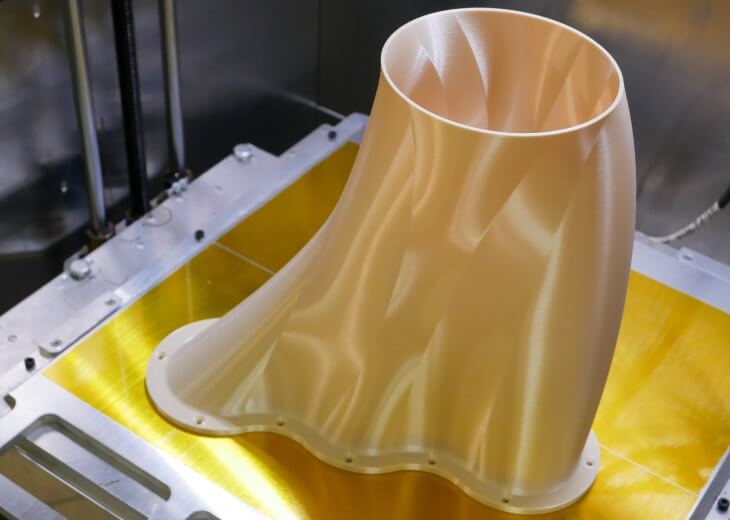
Having access to the right FDM/FFF 3D printer can unlock a whole new world of hardy and resilient thermoplastics. With their enhanced mechanical, thermal, and chemical properties, these materials can be used to produce stronger and lighter parts capable of withstanding the most punishing environments on Earth, and even beyond.
Because of the nature of these materials, they are generally more difficult to print than regular thermoplastics. In particular, the same properties that make the material high performance, are the very same properties that make processing difficult.
In short, if you want to start printing from the top of the polymer pyramid, you’re going to need a very hot machine, with a well controlled thermal environment.
In this article, we will take an overview of these materials, their uses, and what you will need to print them.
The Chemistry Behind High-Performance Polymers
With regards to the polymer pyramid, the materials examined in this article will come from the high performance tier. Such materials include PEI, PEEK, PAEK, PPS and PSU.
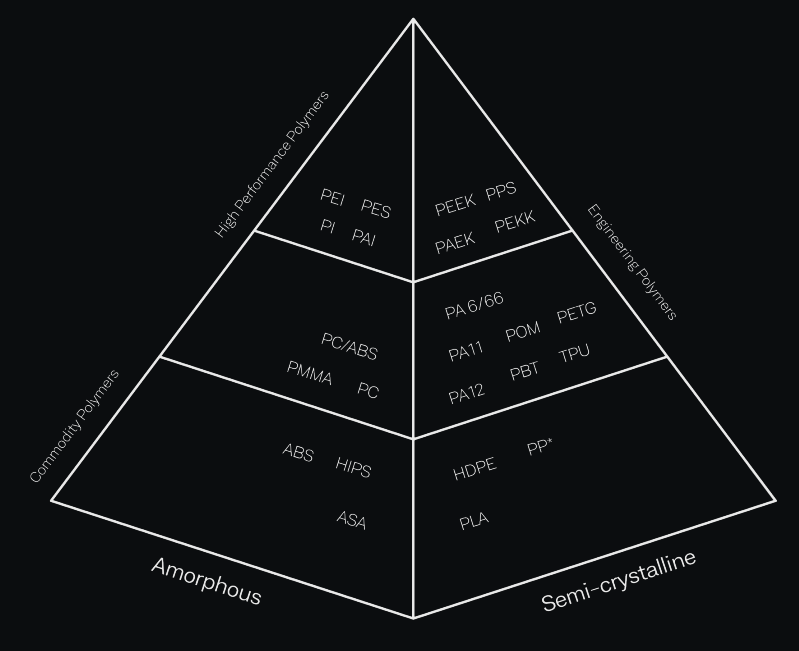
It is the unique chemistry found within high performance polymers that gives these materials their enhanced characteristics.
Specifically, the following key chemical properties contribute to making high performance plastics what they are.
Aromatic Rings
One of the key differences between high performance 3D printing feedstocks and other plastics further down the pyramid is the combination of a high concentration of aromatic rings within the polymer backbone and thermally stable chemical linkages connecting them.
Most high-performance thermoplastics used in 3D printing, including PEEK, PEI, PPS and PSU, contain aromatic (benzene) rings in their molecular backbones. Because Benzene rings are planar and fairly rigid, adding them to a polymer’s backbone can restrict the chain’s movement, thus making rearrangement more difficult.
Electron Delocalisation
Benzene has its six π electrons spread across the entire ring structure, instead of having these electrons restricted to individual carbon–carbon double bonds. This increases the stability of the molecule thanks to the lowered energy state resulting from the placement of these electrons.
Chemical Linkages
The groups connecting the aromatic rings also affect the performance of the printed part. For example, PEEK contains ether and ketone linkages, PEI contains ether and imide groups, PPS contains sulfide linkages, and PSU contains ether and sulfone groups.
As a direct result of these chemical properties, high performance plastics gain the attributes that give the whole polymer group its name.
Properties Derived from Chemical Composition
The chemistry of high-performance polymers gives these materials three key attributes of thermal stability, chain rigidity and molecular mobility.
The enhanced thermal stability of high performance plastics at elevated temperatures is the result of the combination of the strong carbon-carbon bonds and delocalized electrons.
The aromatic rings present in these plastics contribute to the rigidity of their respective polymer chains, which restricts molecular movement. This generally contributes to higher glass transition temperatures (Tg) of the plastic, as well as improved stiffness at elevated temperatures during use.
Flexible linkages (such as ethers), allow greater chain movement within the molecule, whereas rigid groups such as imides tend to restrict it. The balance affects the glass transition temperature, processability and mechanical properties of the final part.
Amorphous vs Semicrystalline
High performance polymers can be generally divided into two distinct categories – amorphous or semicrystalline. Amorphous polymers consist of disordered, random polymer chains, while semicrystalline polymers have more ordered, crystalline structures.
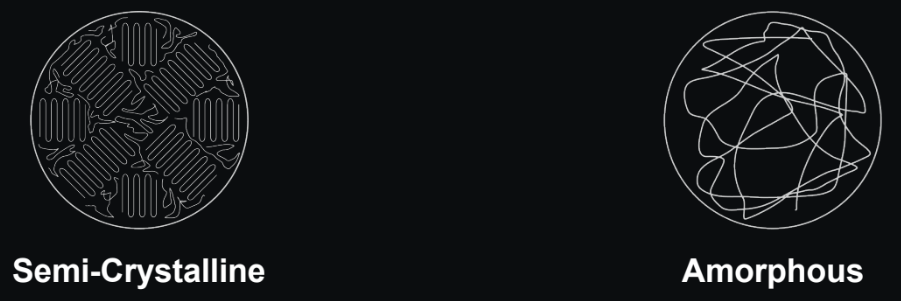
Depending on which type of polymer is being used, each comes with its own pros and cons in terms of material properties and processing requirements.
There are several factors that determine whether a polymer is either amorphous or semicrystalline.
Molecular Structure
Not all polymers can crystallize. Not all can become amorphous. The type of molecule is the primary driver of determining if a polymer will crystallize or not.
In short, regular, symmetrical, flexible polymer chains can crystallize more easily. Molecules with bulky side groups, irregular structures and branching hinder molecular packing, will tend towards forming amorphous structures.
Cooling Rate
The rate at which a part cools is a huge factor in determining if crystallization occurs (molecule-type permitting). When a suitable polymer is allowed to cool slowly, the chains have time to rearrange into ordered crystalline regions.
Conversely, when an appropriate polymer cools quickly, molecular movement becomes restricted and the chains are trapped in a disordered, amorphous state.
Effects on Material Properties and Process
As there are changes occurring at the molecular level during the plastic solidification process, there are also changes at the macro level, in terms of material properties and also in how the material is printed.
Crystallization generally improves stiffness, chemical resistance and elevated-temperature performance. On the negative side, crystallization can increase shrinkage, warping and the complexity of the printing process.
Amorphous structures, on the other hand, generally offer easier printing and better dimensional stability.
These trends are generally true for high performance polymers, although actual performance depends on polymer chemistry, grade and processing conditions.
The table below also shows general comparisons between the two types in terms of material properties and processing complexity.
| Property / Process | Amorphous | Semicrystalline |
| Strength and stiffness | Generally lower | Generally higher |
| Toughness and ductility | Often higher | Often lower |
| Heat resistance | Softens significantly above Tg | Retains stiffness above Tg, up to near Tm |
| Chemical resistance | Generally lower | Generally higher |
| Wear and creep resistance | Generally lower | Generally higher |
| Shrinkage and warping | Lower | Higher due to crystallization |
| Dimensional accuracy | Generally better | More difficult to control |
| Printing requirements | Wider processing window | Tighter thermal control needed |
| Cooling | Rapid cooling can preserve amorphous structure | Controlled cooling promotes crystallization |
| Post-processing | Annealing primarily relieves residual stresses | Annealing can increase crystallinity |
Types of High Performance Plastics
In this section, we will take a look at the most commonly available high performance polymers used in extrusion-based plastic additive manufacturing.
PEI
PEI (polyetherimide), also known by its brand name ULTEM is a polymer prized for its high strength, thermal resistance, flame resistance, and in some varieties, its enhanced chemical resistance.
It is an amorphous thermoplastic, and appears as either an opaque beige color, or as a translucent amber color, depending on formulation and process.
The bulk plastic is available in several varieties including ULTEM 1000/1010, ULTEM 2200/2300, and for additive manufacturing, it is commonly found as the ULTEM 9085 variety.
ULTEM 9085 is used extensively in aerospace, particularly in cabin-interiors where its low weight and excellent FST characteristics make it the ideal choice.
PEEK
PEEK (Polyether ether ketone) is a semicrystalline thermoplastic, and has similar mechanical properties to PEI, but with the added advantage of improved chemical resistance.
This chemical stability not only means that PEEK is an ideal choice for chemically aggressive environments, but makes it resistant to reacting in physiological environments too. In other words, it’s a biocompatible plastic that can be used in medical implants.
PEEK is also radiolucent, which contributes to its effectiveness as an implantable material, because it does not obscure X-rays.
PEKK
PEKK (polyetherketoneketone) differs from PEEK and PEI in the sense that it can be tailored to be either an amorphous or a semicrystalline plastic. The ability to fine tune PEKK in this manner provides flexibility in both processing, and the final material properties.
In its semicrystalline form, PEKK generally offers superior chemical resistance and higher continuous operating temperatures.
Semicrystalline PEKK also provides better dimensional stability in service, particularly under sustained loads and elevated temperatures, thanks to the material’s greater stiffness and creep resistance.
In its amorphous form, PEKK benefits from greater ductility and toughness, making it less brittle and better able to accommodate deformation before failure. It is easier to process due to its wider thermal processing window. Because amorphous PEKK undergoes reduced crystallization-related shrinkage, it can be printed with a higher level of dimensional accuracy during printing.
PPSU
PPSU (Polyphenylsulfone) is a strong, high-performance amorphous thermoplastic with exceptional toughness, thermal resistance, chemical resistance and dimensional stability. These attributes make PPSU suitable for a range of applications used in fairly extreme environments.
Chemically, PPSU is a member of the polysulfone family of polymers. The PPSU molecule consists of aromatic benzene rings connected by sulfone groups, along with ether linkages that connect the benzene rings into a polymer chain.
PPSU is particularly useful for medical devices, sterilisation trays, surgical instrument handles, fluid-handling equipment and impact-resistant aerospace components.
PPS
Polyphenylene sulfide (or “PPS” for short) is a semicrystalline thermoplastic available in filament form, known for its high chemical and thermal resistance, as well as excellent electrical insulating properties.
The molecular structure of PPS consists of aromatic benzene rings connected by sulfur linkages. These chemically stable bonds contribute to its resistance to aggressive chemicals.
3D printed PPS has been used to manufacture functional parts including chemical-resistant valves, pumps, impellers and other fluid-handling components, as well as electrical connectors, insulating components and automotive parts.
TPI
Thermoplastic Polyimide (TPI) is a high performance polymer with ultra-high isotropy, thermal stability, good chemical resistance, inherent flame retardancy, and great printability.
Polyimides can come in both thermoset and thermoplastic variants. For extrusion-based additive manufacturing, TPI is the polyimide of choice, as it is a melt-processable thermoplastic.
TPI is available in both amorphous and semicrystalline grades. Depending on the variety, TPI materials can offer glass-transition temperatures around 250°C or higher, allowing them to retain useful mechanical properties at temperatures beyond the capabilities of many other engineering thermoplastics.
TPI is used in aerospace, automotive, electronics and semiconductor manufacturing, particularly for high-temperature structural components, electrical insulation, precision parts and wear-resistant components.
For 3D printing, TPI requires extremely high processing temperatures, often approaching or exceeding 400°C, depending on the type.
How to Print?
There is no singular rule or setup that will allow you to print all of these plastics successfully.
However, one thing that all of these filaments have in common, is the need for a high-temperature 3D printer that offers a controllable thermal environment. The video below shows the consequences of printing outside the preferred thermal window has.
As an overview, the table below shows the very minimum requirements for printing the high performance plastics mentioned in this article. The biggest asterisk comes with the chamber temperature, as 90°C lets you print some of those materials in very limited size and geometry, but will mostly fail with any intricate geometry or large sizes.
| Process Parameter | Value |
| Nozzle temperature | 390°C minimum |
| Bed temperature | 140°C minimum |
| Chamber temperature | 90°C minimum, actively heated |
| Build platform material | High-temperature-compatible build surface, selected for the filament |
| Bed adhesive required | Yes |
Choosing the Right Material
As mentioned previously, high-performance plastics are valued for their individual properties, rather than the general ones which is the case for engineering and commodity plastics.
The table below shows the key distinguishing properties for each high-performance polymer in this article, which should assist with your material selection process.
| Material | Key distinguishing property | Common use |
| PEI (ULTEM) | Excellent flame, smoke and toxicity (FST) performance | Aerospace cabin interiors |
| PEEK | Radiolucency and biocompatibility | Medical implants, particularly spinal implants |
| PEKK | Tailorable crystallinity | Control printability, dimensional accuracy and mechanical performance |
| PPSU | Exceptional resistance to repeated steam sterilisation | Reusable surgical instruments and medical equipment |
| PPS | Exceptional resistance to aggressive chemicals | Pumps, valves and chemical-processing components |
| TPI | Ultra-high temperature capability | Components exposed to extreme operating temperatures |
Summary
As seen in this article, the ability to print (reliably) at elevated temperatures unlocks an entire new palette of high performance plastics that can be used in the most demanding of environments.
And as mentioned, the very material properties that make these plastics high performance, and the very same properties that make them hard to print. But with the right hardware, and the correct process parameters dialled in, printing with such materials need not be an impossible task.
So to summarize, if you need a general plastic that performs well across the board, then pick an engineering plastic.
But if you need a material that goes above and beyond conventional plastics, with specialized properties tailored towards use in extreme environments, then the high-performance plastics listed in this article might hold the solution that you’re looking for.