Industrial 3D Printer Buyers Guide
Over 77% of printers marketed for high performance polymers can’t reliably print PEEK or ULTEM. Make your next investment with confidence, not consequences.

TPI (thermoplastic polyimide) is a high performance thermoplastic 3D printing material, most commonly found for FDM/FFF type additive manufacturing systems.
Not to be confused with thermoset polyimide variants, TPI is prized for its high tensile strength, high thermal stability, and excellent isotropic behavior. In addition, TPI offers great chemical resistance, low flammability, and easy print processing.
This combination of characteristics makes thermoplastic polyimide well-suited for a range of industries where resistance to harsh environments is desirable. As such, it is becoming increasingly popular in sectors such as aerospace, automotive, chemical, oil & gas, and industrial manufacturing.
In this post, we will take a look at what sets TPI apart from other additive manufacturing thermoplastic filaments, as well as delving into what is required to print this high grade polymer.
Material Structure and Its Relevance to Printing
Thermoplastic polyimide materials come in both amorphous and semi-crystalline variants, depending on the grade. Consequently, there will be variations of the structure according to whether the grade in question is amorphous or semi-crystalline.
But in the general case, the structure of TPI is based on imide-containing repeat units built into a rigid polymer backbone, often with aromatic structures. This build contributes to the TPI’s core properties like high thermal stability, mechanical performance, dimensional stability, and inherent flame resistance.
Whether the final bulk material behaves as an amorphous or semi-crystalline thermoplastic depends on the exact backbone chemistry, monomer selection, and particular formulation.
The distinction is important for those wishing to print with TPI, because the morphology affects the rheology of the material, particularly in terms of how it flows, cools, shrinks, and maintains its dimensional stability after extrusion.
For example, TPI polymers such as EXTEM TPI are amorphous and can benefit from lower crystallization-related shrinkage, resulting in higher dimensional stability. This can come at the expense of wear resistance and fatigue resistance. Amorphous thermoplastics can also be more susceptible to stress cracking compared to their semi-crystalline counterparts.
On the other hand, materials like AURUM TPI are semi-crystalline, and have higher mechanical strength, stiffness, chemical resistance, as well as being more resistant to high temperatures. On the negative side, semi-crystalline polymers can experience higher shrinkage during cooling, increased risk of warping and distortion, and generally lower dimensional stability. Semi-crystalline thermoplastics can be harder to print, and typically require tighter thermal controls while printing.
Polyimide Printing Temperatures
| Description | Value |
| Printer nozzle temperature | 390 – 410°C |
| Heated bed temperature | 120 – 160°C |
| Chamber temperature | 80 – 160°C |
| Print Speed | 15 – 150 mm/s |
| Bed Material | Glass, Carbon plate |
| Bed Adhesion | Magigoo HT ,Nano polymer adhesive, GeckoTec EZ-Hot |
| Pre drying recommendations | 120°C, >4 hours |
Printer Features You Need
While TPI is said to be an “easy” filament to print, in terms of low print failures, the printer that you are using to print it still has some minimal requirements, particularly in terms of thermal capabilities.
Say for example that you wanted to print with the PI Z2 filament, from 3D4Makers/Zymergen. The PI Z2 filament is an amorphous variant, and so has high dimensional stability, due to the fact that it does not undergo crytallization-related shrinkage and warping during cooling.
In order to print PI Z2, you will firstly need a high temperature nozzle/hotend, capable of reaching temperatures of 390 – 410°C. This temperature is generally higher than what most consumer-grade machines are capable of, and the filament manufacturers recommend using a hardened steel or ruby nozzle.
Secondly, a heated bed with a temperature range of 120 – 160°C is needed. While PI Z2 is marketed as a low warp filament, due to its amorphous nature, it can still undergo warping on the first layers due to the high extrusion temperature. Extruding at 390 – 410°C onto a cold bed would inevitably result in a large thermal gradient, and this could potentially cause warping, delamination, and buildup of residual stresses in the first layers, regardless of if the material was amorphous or semi-crystalline.
Because PI Z2 has a high glass transition temperature of 193°C, the 120–160°C bed temperature remains below Tg while still keeping the first layers hot enough to reduce thermal shock, improve adhesion, limit shrinkage stresses, and help maintain dimensional stability during the early stages of the print.
To improve bed adhesion even further, the manufacturer recommends using bed adhesives such as Magigoo HT, Nano polymer adhesive, GeckoTec EZ-Hot. A glass or carbon plate bed surface is recommended for optimal printing.
Finally, an actively heated build chamber is recommended in order to maintain a printing environment of between 80–160°C. This helps control the thermal environment around the entire part, rather than only the first layers, reducing temperature gradients as the print grows in height.
By slowing the cooling rate of newly deposited material, the heated chamber helps limit residual stress, warping, cracking, and layer separation, while giving adjacent roads and layers more time to bond before the polymer stiffens.
Common Issues with Polyimide Printing
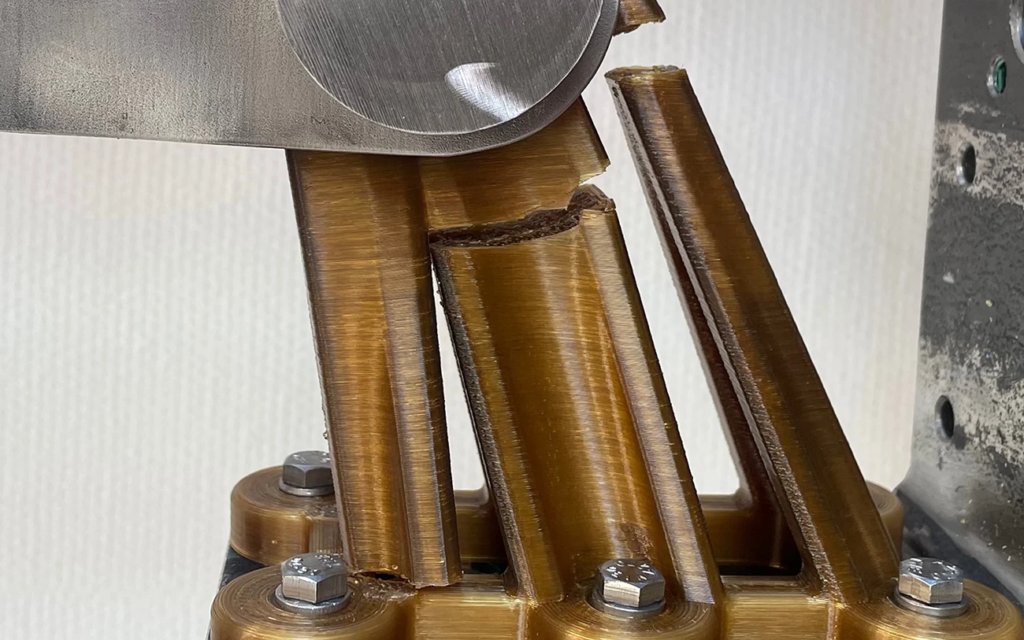
As mentioned, TPI is said to be an “easy” filament to print, but this should be considered in the context of other high performance polymers. Sure, it’s easier to print than ULTEM or PEEK, but is nowhere near as easy as printing PLA for example.
And the “ease” at which TPI prints is contingent on the printing parameters being optimal, and the material being in good condition.
On that last point, moisture absorbtion can be an issue when printing with TPI. Average values for moisture absorption of TPI are around 0.34% over 24 hours, which places it in the same ballpark as ULTEM in terms of how much water it will absorb from the atmosphere. This is not as high as Nylon (around 0.5%) but can still be considered moderately hygroscopic. Because of the high extrusion temperature of TPI, this can result in water flashing into steam in the nozzle, causing popping and spluttering, which can cause defects in the appearance and mechanical properties of the final print.
For this reason, TPI should be dried at 120°C for over 4 hours if you suspect that it has absorbed too much moisture. Because improper drying or excessive and repeated drying can degrade the material, it is always preferable to keep the material dry in the first place rather than drying it after the fact.
Another issue can be the reduction in bond layer strength, which can result from printing at below the recommended nozzle temperature, or with a low chamber temperature. Given that TPI is valued for its high isotropy and excellent z-axis strength, care should be taken to ensure that all printing temperatures are as per recommendation to ensure optimal material properties.
Bed adhesion can also be an issue, particularly when printing large, flat parts. To avoid such issues, it is recommended to print at the correct bed temperature, and by use of bed adhesives, as mentioned earlier.
In short, following the manufacturer’s guidelines and use of a reliable 3D printer designed for high temperatures will ensure that you will achieve succesful and high quality prints, time and time again.
Polyimide Applications
| Sector | Why TPI? | Typical printed parts |
| Aerospace and aviation | High flame resistance, high strength-to-weight ratio, thermal stability, and dimensional stability | Internal aircraft components, high-temperature insulation parts, brackets, seal rings |
| Space and rocketry | Low weight, high thermal stability, mechanical strength, and inherent flame resistance | Lightweight replacement parts, internal spacecraft components, rocket-adjacent high-temperature parts |
| Rail | Flame, smoke, and toxicity performance for railway applications, especially where EN45545-2 compliance is required | Interior seals, electrical housings, connectors, small technical components |
| Automotive and EV | Heat resistance, wear resistance, chemical resistance, and strength retention at elevated temperatures | Sensor housings, electrical connectors, bearings, thrust washers, transmission seal rings |
| Semiconductor manufacturing | Low outgassing, dimensional stability, high-temperature resistance, wear resistance, and plasma resistance | Wafer handling parts, test fixtures, low-contamination tooling, sliding or wear components |
| Electrical and electronics | High dielectric strength, thermal stability, and flame resistance | Insulators, connector bodies, electrical housings, high-temperature fixtures |
| Industrial, chemical, oil and gas | Chemical resistance, high-temperature performance, wear resistance, and low-friction behavior | Pump components, valves, oil seals, impellers, guide rings, gears |
When to Choose Polyimide Over Other Plastics?
TPI is not a budget or consumer grade material. It is a specialist plastic, with certain benefits that will apply to certain applications over others. So why would you select TPI over other filaments of the same price range?
For starters, TPI ranks very highly for isotropy / z-axis strength (higher than ULTEM even). So if you are designing and printing parts that undergo significant loading in multiple directions, TPI is a very good option.
Secondly, it has high temperature resistance and shows excellent FST characteristics. So if you are looking to manufacture parts where flame, smoke and toxicity behavior is important (such as human transportation scenarios) then TPI is a great choice.
Finally, to complement that last point, certain TPI filaments are certified for use in the rail transportation sector. Specifically, PI Z2 filament has passed EN45545-2 HL1/2/3 certification according to requirements R22/R23. For context, EN 45545-2 is the European fire-protection standard for railway-vehicle materials, and R22/R23 are requirements pertaining to fire behavior for internal/external rail applications.
To summarize, if you’re in the market for a high-performance thermoplastic with high isotropy, excellent FST characteristics, with high dimensional stability, high temperature resistance, and resistance to chemicals, or if you specifically want to build train components knowing that they already meet that particular industries FST requirements, then TPI might be an ideal choice.
Achieve New Levels of Part Performance & Throughput
3D print the world's highest performance polymers - bigger, faster, and stronger than ever.