Industrial 3D Printer Buyers Guide
Over 77% of printers marketed for high performance polymers can’t reliably print PEEK or ULTEM. Make your next investment with confidence, not consequences.

Polyimides are a family of high-performance polymers that can be thermoset or thermoplastic. This article discusses thermoplastic polyimide (TPI), which offers excellent processability in addition to high thermal stability, flame retardancy, and radiation resistance.
TPI is used to manufacture parts with high rigidity, excellent creep resistance and low coefficient of thermal expansion for demanding applications, such as aerospace and electrical engineering.
This article reviews TPI’s properties, the applications enabled by these properties and the different manufacturing methods used to produce parts from the polymer.
What is Thermoplastic Polyimide?
Polyimide can be either thermoplastic or thermoset, depending on the monomers used to fabricate them and their chain interactions.
Thermoplastics exhibit different properties from thermosets. Thermoplastics are recyclable because their degradation temperatures are higher than their melting points, while thermosets aren’t because they degrade before melting. In contrast to thermosets, TPI exhibits better processability, making it suitable for injection molding and 3D printing.
TPI was first developed in the 1970s by NASA as a high-temperature organic adhesive. It offers good strength and toughness as well as high damage tolerance, extending its lifetime and enhancing its environmental profile.
Thermoplastic Polyimide Material Structure
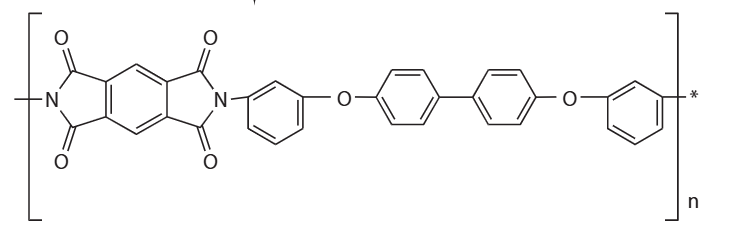
Polyimides can be classified based on the composition of their main chain into aliphatic polyimides (linear polyimides), semi-aromatic polyimides, and aromatic polyimides. Aromatic polyimides are the most common because of their thermal stability.
Thermoset PI forms a permanent cross-linked network, whereas thermoplastic PI exhibits linear or branched molecular chains attached together with non-covalent bonds, such as Van der Waals and π–π stacking.
Polyimides are composed of repeated aromatic rings with imide linkages. TPI molecular structure features a strong aromatic backbone, with strong molecular interactions, which provide it with excellent mechanical properties as well as thermal and oxidative resistance.
TPI is available as both amorphous and semi-crystalline polymers. For example, EXTEM TPI is an amorphous polymer, whereas AURUM TPI is a semi-crystalline polymer. The final structure of the polymer depends on the polyimide synthesis, precursors (e.g., polyamic acid vs polyamic acid salts) and final composition.
Thermoplastic Polyimide Material Properties
As mentioned above, the properties of polyimides depend on their specific grade/type and manufacturer. Here, we present average properties of TPI.
TPI Physical and Mechanical Properties
| Property | Typical value/Rating |
| Density | 1.33 to 1.52 |
| Tensile Strength | 65 to 125 MPa |
| Flexural Strength | 137 to 220 MPa |
| Impact Strength | 5.3 (notched)-26 (unnotched) kJ/m² |
| Young’s Modulus | 1 to 5.6 GPa |
| Flexural Modulus | 0.9 to 3.8 GPa |
| Hardness | 126 to 129 (Rockwell) |
| Elongation at Break | 57% to 90% |
| Creep Resistance | low creep rate at high temperatures |
| Coefficient of Friction | 0.25 to 0.42 |
TPI offers exceptional mechanical properties. Similar to other high-performance polymers, it offers much higher strength-to-weight ratio compared to metals, with a density (1.33-1.52) that is 1/6 that of steel and half that of aluminum.
Strength and toughness
TPI offers a very high tensile (approx 89 MPa for Tectonic3D Vulcan TPI) and impact strength (5.3 and 26 kJ/m² notched and unnotched respectively) comparable to PEEK. This makes TPI one of the best candidates for weight-sensitive applications requiring strong and tough materials, such as aerospace and automotive applications.
Stiffness
Some commercial grades of TPI, such as the AURUM, exhibit superior tensile and flexural moduli, reaching 5.6 and 3.8 GPa, respectively, allowing them to be used for applications requiring high stiffness, such as industrial applications. For the Vulcan filament, the tensile modulus stands at 2.89 GPa.
Hardness and deformation
TPI exhibits high hardness (126-129, Rockwell R) and creep resistance, giving it superior deformation resistance and dimensional stability. Moreover, the polymer’s excellent elongation at break gives it excellent deformation characteristics and low brittleness.
These excellent properties allow these polyimide polymers to be used in applications where they are under constant stress at high temperatures.
Wear resistance
TPI has a low, stable coefficient of friction and low friction wear even at high temperature and pressure. Some filled TPI grades further enhance this property. These tribological properties allow TPI to be used for parts like bearings, O-rings, and seals for demanding applications.
TPI Thermal Properties
| Property | Typical value |
| Glass Transition Temperature (Tg) | 195 to 250 °C (depending on the type/grade) |
| Melting temperature (Tm) | 210 to 400 °C (depending on the type/grade) |
| Heat Deflection Temperature (HDT) | 175 °C @ 0.45 MPa-167 °C @ 1.8 MPa (reaches 230 °C for some types/grades) |
| Operation Temperature Range | -40 to 240 °C (upper limit depends on the grade) |
| Thermal Conductivity | 0.11 to 0.3 W/m.K |
| Coefficient of Linear Thermal Expansion (CLTE) | 20 to 55 × 10⁻⁶ /°C |
TPI shows exceptional heat resistance, with some grades showing a continuous operation temperature of 240 °C. It also exhibits exceptional heat deflection temperature up to 230 °C. In addition, TPI has a moderate (neat) to low (filled) CLTE, giving it decent dimensional stability.
Thus, thermoplastic polyimides are excellent materials for high temperature applications. For example, TPI is used to manufacture tubes, film coatings, and semiconductor parts in industrial applications.
TPI Chemical Properties
| Property | Rating |
| Solubility in Different Solvents | Pure TPI is resistant to most organic solvents and susceptible to strong chemicals |
| Oxidation Resistance | Good to high (depending on the type/grade) @ moderate temperatures |
| Flammability UL94 (0.4mm) | V0 (self-extinguishing) |
| Limiting Oxygen Index (LOI) | 45 to 47% |
| Moisture absorption | 0.34% |
Hydrolysis and chemical resistance
Polyimide TPI has a good chemical resistance to most organic solvents, oils, and diluted acids and bases. However, it is vulnerable to strong acids and bases under elevated temperatures.
Thermoplastic polyimide is susceptible to prolonged exposure to steam, resulting in the hydrolysis of the imide bond. While some grades of TPI are not fully vulnerable to hydrolysis, they experience property degradation after prolonged exposure to water, especially at high temperatures. Therefore, TPI is not suitable for medical equipment subjected to constant sterilization.
Flammability
TPI has inherent flame retardancy, making it an excellent choice for applications sensitive to fire hazards such as aerospace applications.
TPI Electrical Properties
| Property | Typical value |
| Dielectric Constant | 2.87 to 3.5 |
| Dielectric Strength | 15 to 55 kV/mm (High electrical insulation) |
TPI exhibits excellent dielectric properties. Owing to these excellent dielectric properties, polyimide films and coatings are outstanding electrical insulators.
Other Qualities
Plasma and radiation resistance
TPI is resistant to ionizing radiation and high-energy plasma. Combined with the excellent thermal and mechanical properties of TPI, this resistance makes it an excellent material for nuclear engineering applications.
Dimensional stability
The high dimensional stability of TPI can be attributed to its excellent properties, especially high Tg, low creep, stable CLTE. However, tight tolerances can only be achieved by post-curing to control the crystallinity of TPI.
Thermoplastic Polyimide Applications
Automotive
TPI is an excellent alternative to metals in automotive applications because of its high strength-to-weight ratio.
Owing to its excellent wear resistance, invulnerability to lubricants, and high strength at high temperatures, TPI can be used to manufacture bearings, transmission seal rings, and thrust washers. Some of these parts, such as bearings, use polyimide base integrated with metals.
TPI can also be used to manufacture parts with high-heat resistance for electrical systems such as sensor housings and connectors.
Industrial
In chemical, oil, and gas industries, TPI, especially carbon-filled grades, is used to manufacture corrosion-resistant, high-heat resistant valves and pump components, such as oil seals and impellers.
Due to its low friction properties, TPI can be used to manufacture parts operating under oil-free lubrication conditions at high temperatures, such as piston rings and guide rings. This enables other use-cases subject to constant wear such as guide rails and gears.
Aerospace
TPI is used for internal components of aircraft and spacecraft owing to its high flame retardancy and strength-to-weight ratio. Another application is for high-temperature parts, such as insulation components and seal rings, in jet and rocket engines.
Electrical and Electronics
Due to its exceptional dielectric properties, TPI can be used as an insulator material for wires, cables, and devices as well as in insulation coatings for magnet wires used in motors, rotors, electric vehicles.
TPI can also be used for EMI shielding in sensitive fields, such as in military applications. TPI films are used as substrates for flexible printed circuits used at high temperatures. Owing to its low outgassing, high-temperature resistance, excellent dielectric properties, and plasma resistance, TPI parts can be used in wafer handling and testing processes.
Polyimide TPI Composites, Blends, and Specialized Grades
Friction and Wear Polymer Grades
These are grades formulated specifically to improve wear resistance. They feature enhanced molecular structures that maximize the TPI’s inherent self-lubricating properties. These grades have wear rates that are 20-50 times lower than conventional TPI grades. They are used in the semiconductor industry, which requires high wear performance and low outgassing and contamination levels for cleanroom environment.
Blends: EXTEM TPI
The best-known TPI blend is EXTEM TPI developed by SABIC. EXTEM has one of the highest continuous operation temperatures for unfilled grades, with improved wear resistance. For example, the EXTEM UP subfamily is a blend of PEEK and TPI, enhancing its chemical resistance while maintaining its high use temperature.
These properties combined with its very high strength-to-weight ratio allow it to replace metals in continuous use applications.
Composites
TPI matrix can be filled with carbon fiber or glass fiber.
Carbon fiber-reinforced
Carbon fiber reinforced TPI grades combine the strength of carbon fiber with the thermal resistance and high continuous service temperature of TPI. Carbon fiber reinforcement also increases the overall mechanical performance of the composite. Carbon fiber reinforcement enhances the cyclic performance of TPI (fatigue strength: 60% of UTS @10⁶ cycles and 50% of UTS @2*10⁶ cycles). These grades are ideal for aerospace applications.
However, carbon fiber reduces the insulation performance of TPI. Thus, it is not the correct choice for electrical insulation applications.
Glass fiber-reinforced
Glass fiber also enhances TPI mechanical strength and maintains its exceptional thermal performance, but to a lower extent than carbon fiber. It also improves the ability to achieve very tight tolerances, making it suitable for high-precision applications at a lower price point than carbon fiber. Glass fiber increases the weight of the polymer making it less suited to aerospace applications.
However, glass fiber enhances the insulation properties of TPI, making it an excellent choice for electrical insulation.
Comparison to Similar Polymers
| Property | TPI | PEEK | PEI (ULTEM) | PEKK |
| Continuous operating temperature | 240 °C (most common commercial classes) | 260 °C | 170 °C | 260 °C |
| Thermal stability | Very high | Highest | Moderate | High |
| Mechanical properties at high temperatures | Excellent | Most consistent performance | Good up to 170°C, drops off above | Excellent |
| Biocompatibility | Not certified | Certified (certain grades) | Certified (certain grades) | Certified (certain grades) |
| Chemical and hydrolysis resistance | Moderate | Excellent | Moderate | Excellent |
TPI exhibits exceptional mechanical, thermal, and electrical properties as well as radiation resistance and wear resistance comparable to PEEK and PEKK. However, due to TPI’s susceptibility to hydrolysis, PEEK is better suited for medical implants and tools. ULTEM too is more suited for medical tools and equipment undergoing repeated sterilization than TPI.
ULTEM offers a more competitive price compared to TPI, making ULTEM a better choice for applications with moderate requirements.
The chemical stability of TPI is lower than that of PEEK and PEKK as it exhibits poor resistance to concentrated acids and bases.
However, TPI has superior electrical properties, making it a good fit for insulation and shielding applications.
Polyimide in Manufacturing and 3D Printing
Injection Molding
Injection molding can be used for TPI but not for thermosetting polyimides. In this process, TPI resin is first dried under vacuum. The melt temperatures in this process are typically 350–370°C and the mold temperatures are 150–160°C.
This process is relatively long compared to other common methods, requires expensive equipment, and sometimes annealing as a last step to further stabilize part dimensions. The upside is high precision and possibility to produce complex components.
Compression Molding
In compression molding, thermoplastic polyimide powder is placed in a mold and heated to 300 °C. Next, pressure (50 MPa) is applied and the temperature is increased to 420 °C, followed by cooling.
This technique is typically used for batch production and to manufacture thick parts, large sheets, and block materials.
Extrusion
Extrusion is mainly used to produce parts with continuous cross-sections, such as rods, tubes, films, and wire coatings. Similar to injection molding, this technique requires drying as a first step. TPI is then melted at 350°C – 400°C, and the molten TPI is forced into a die with a specific shape. This is followed by cooling to stabilize the part dimensions.
3D Printing
Fused filament fabrication (FFF), also called fused deposition modeling (FDM), is the only practical way to 3D printing TPI. The polymer is dried, fed as filament into a high-temperature printer, melted, and deposited layer by layer to build parts too complex or too low-volume to justify mold tooling.
TPI’s narrow processing window, high melt viscosity, and high viscous flow temperature push FFF hardware to its limits, meaning any desktop printer is no good for the job and and an industrial high temp printer is necessary.
The printer has to withstand nozzle temperatures up to 445°C, bed temp up to 220°C and maintain a chamber temp as high as 240°C, depending on grade. Filament must be dried at 120 to 150°C for 4 to 8 hours before printing, and carbon-fiber-filled grades require a hardened steel or ruby nozzle to handle the abrasive load.
The result is dimensionally accurate, isotropic parts used for semiconductor wafer handling, aerospace brackets, and high-temperature electrical connectors, where flame retardancy and low outgassing rule out lower-tier polymers.
Great Properties You Can Print
In summary, TPI is a unique high-performance polymer with exceptional mechanical and thermal properties as well as outstanding insulation ability. It is ideal for critical applications requiring low contamination levels such as semiconductor engineering applications. In addition, it can replace metals in some aerospace and automotive applications due to its low weight and inherent flame retardancy.
TPI can be manufactured by conventional methods, such as injection and compression molding, as well as 3D printing for highly precise and complex parts.
Achieve New Levels of Part Performance & Throughput
3D print the world's highest performance polymers - bigger, faster, and stronger than ever.